The blind spot
Existing SEO dashboards only see Google rankings — not how ChatGPT, Gemini, Perplexity, or Claude describe you. Most brands find out only after customers are lost to wrong answers.

VISABLE.AI | AI VISIBILITY × GA4/GSC
VisAble.AI starts by reading your brand and your industry — crawling the corpus and building a dedicated knowledge base — then derives real buyer questions and runs live, batched queries against ChatGPT, Gemini, Perplexity, and Claude: visibility is measured from real answers, not estimated. Gaps go straight to PVL AutoGEO, which produces content to close them; results connect to your existing GA4 and Search Console, so you can verify whether being cited by AI actually turned into traffic. Not another monitoring report — a capability that keeps evolving.
In production: enterprise engagements running with a leading ICT group and a smart-city integration provider
Buyers no longer ask only Google. When they ask ChatGPT which vendors in your industry can be trusted, the paragraph AI returns is your new front door — and most brands have never read it.
Existing SEO dashboards only see Google rankings — not how ChatGPT, Gemini, Perplexity, or Claude describe you. Most brands find out only after customers are lost to wrong answers.
Wrong facts, outdated services, even competitors' strengths attributed to your name — today these surface only when a customer complains.
Market tools give you an isolated share-of-voice report, disconnected from your GA4 and Search Console. They cannot answer: after the citation, did anyone actually come?
Pure monitoring tools repeat what AI said — sometimes repeating the hallucination verbatim. They never tell you what content to publish next.
WHY VISABLE.AI
Few solutions anywhere close the full loop — measure, fix, verify — in one system. That is why we can afford to lay the whole methodology open.
A brand-specific knowledge base comes before any question — so questions carry your industry’s real semantics, not generic templates. Market tools skip this groundwork.
Live, batched queries against ChatGPT, Gemini, Perplexity, and Claude — visibility comes from real engine answers.
AI citation data lands on the same chart as your GA4/Search Console — GEO investment finally speaks the language of finance.
Finding the gap is not the end: PVL AutoGEO produces the fix, published after your review. Not a report tossed over the wall.
Results and new corpus flow back into the knowledge base — sharper questions, better fixes. The system evolves instead of restarting.
Two benchmark enterprises in production. Local-language semantics are our home turf — and as the four engines keep changing, we keep watch full-time.
METHODOLOGY
Others take template questions to AI and check whether you were mentioned. We start differently: read your brand and industry, build the knowledge base, then derive the questions — close the gaps, feed the results back, and ask sharper questions next round.
Crawl brand and industry corpus, chunk and embed with RAG, and build your dedicated knowledge base.
This is the groundwork market tools skip. Question quality determines monitoring quality — without a knowledge base, the questions are generic templates that miss your real blind spots.
Derive the questions real buyers would ask from the knowledge base, then run live, batched queries against ChatGPT, Gemini, Perplexity, and Claude to measure visibility in the field.
Questions come from the knowledge base, not templates — and the answers are real engine responses, not simulations or estimates.
Compare AI answers against ground truth: uncited topics, errors and hallucinations, competitor substitution.
Not just "were we mentioned" — which topics are lost, and why.
PVL AutoGEO produces content to close each gap. Once published, results and new corpus flow back into the knowledge base — so the next round asks sharper questions.
A closed loop, not a one-way report. Every cycle makes the knowledge base thicker, the questions sharper, the fixes more effective.
You are not buying a PDF report. You are buying a system that keeps getting smarter.
Where this discipline comes from → AI Operational Excellence
GEO ultimately has to answer a financial question: did that citation bring anyone in? Kept apart, the two datasets give you two self-referential reports. Put together, you can finally compute the return on GEO investment.
No tool migration, no site migration — we connect to the GA4 and Search Console you already run.
AI citation counts, cited topics, and competitor comparison, side by side with organic traffic, clicks, and impressions.
After gap-filling content goes live, track citation changes and traffic changes for that topic together.
Deploying VisAble.AI builds a company-level knowledge base for you. The boundary is explicit from day one: the engine is ours, the corpus is yours. You get usage rights to industry-level knowledge without starting from zero; your proprietary content stays in your own layer and never leaks to competitors.
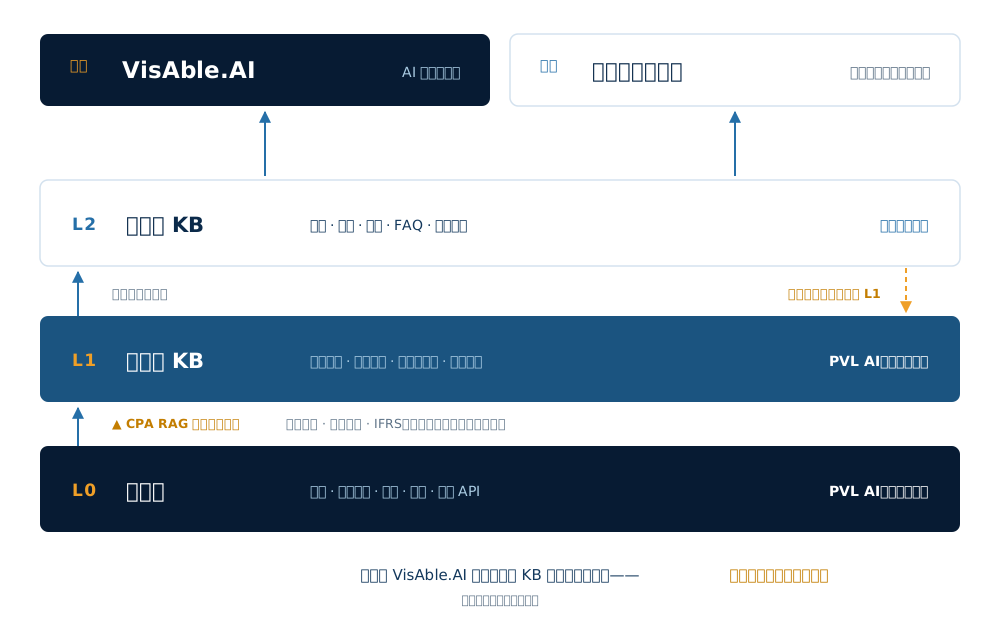
The L0 engine layer (chunking, embedding, retrieval, APIs) is provided and operated by PVL AI; the content of your L2 company-level KB belongs to you, stated in contract.
The L1 industry-level KB — terminology, buyer phrasing, regulations and standards — is built and maintained by PVL AI. You license it and start on top of existing accumulation.
The system gets smarter every cycle, but only de-identified, aggregated signals (which question types work, which topics commonly fail) settle back to the industry level. Your proprietary content never feeds competitors.
And because the knowledge base is yours, it serves more than one purpose — outward, to test how AI describes you; inward, to let your organization search and query its own knowledge. One asset, two directions.
Internal applications are a second-phase track, currently run as pilots.
You realistically have three alternatives: keep the traditional SEO stack, subscribe to an overseas AI-monitoring SaaS, or have an agency watch by hand. Line by line:
| Traditional SEO tools | Overseas AI-monitoring SaaS | Agency manual monitoring | VisAble.AI | |
|---|---|---|---|---|
| Question basis | N/A | Generic question banks | Hand-picked | Derived from a brand-specific knowledge base |
| Visibility measurement | Google rankings | AI mentions and citations (English-first) | A handful of manual checks | Batched live tests on four engines, local-language questions |
| Hallucinations & brand facts | N/A | Repeats what AI said | Found by hand, if at all | Checked against a maintained fact table, with authoritative corrections |
| ROI verification | GA4 yes, AI side missing | Isolated voice metrics | Hard to attribute | AI citations × GA4/GSC on one chart |
| Next step | On your own | On your own | A separately quoted project | PVL AutoGEO produces the fix |
| Does it evolve | No | No (standalone reports) | Depends on the person | Yes (results flow back to the KB) |
| Who owns the knowledge asset | — | Data stays on the vendor platform | Scattered across decks | Your company-level KB, stated in contract |
| Enterprise track record | — | Mostly overseas cases | Case by case | Two benchmark enterprises in production |
"Question basis," "Next step," and "Does it evolve" are structural differences — not feature counts, but things the other architectures cannot do.
ICT / telecom groups
Established digital assets, no interest in rebuilding the website — what they need is visibility and control over how AI describes them.
Smart-city / security integrators
Businesses spanning physical services and digital trust, where an AI mis-statement costs more than traffic.
Other trust-sensitive industries
Finance, healthcare, retail chains — an AI mis-description is a trust and compliance risk, not just lost clicks.
Multi-brand groups
Groups that need unified monitoring of how AI describes each sub-brand across sites.
CASE 01 | Leading ICT group
Defined the GEO playbook and measurement framework for the group, so the brand is correctly cited and recommended in AI answers.
CASE 02 | Smart-city integration provider
A brand spanning physical services and digital trust, deploying AI visibility monitoring and content gap-filling.
Per agreements, cases are described by industry and not named.
VisAble.AI is PVL AI’s AI-visibility product under Growth Platform. It runs live, batched queries against ChatGPT, Gemini, Perplexity, and Claude to measure how each engine actually describes your brand, and integrates that data with GA4 and Search Console. Unlike generic monitoring tools, it first builds a brand-specific knowledge base via crawling and RAG, then derives the test questions from it — visibility comes from real answers, not estimates; diagnosed gaps are closed by content from PVL AutoGEO, and results flow back into the knowledge base — a continuously evolving loop.
Because GEO ultimately answers a financial question: did that AI citation actually bring people in? Apart, you get two self-referential reports; together, you can compute the real return on GEO investment.
No. VisAble.AI connects to your existing website, GA4, and Search Console. It works regardless of whether you use FirstSite AI.
The engine is PVL AI’s; the corpus is yours. The company-level knowledge base built for you belongs to you by contract; the industry-level KB is maintained by PVL AI and licensed to you. Only de-identified, aggregated signals settle back to the industry level — your proprietary content never flows to competitors.
Both run on the same Digital Growth Intelligence engine: VisAble.AI diagnoses which topics fail to get cited by AI; FPS and PVL AutoGEO produce the content that closes the gaps. Diagnosis and treatment are two ends of one loop.
We have validated this method with a leading ICT group and a smart-city integration provider, and are now looking for 3–5 brand enterprises to define the visibility standard of the AI era together.
Founding partners receive:
What we look for:
Or write to us directly: contact@profitvisionlab.ai